

How to Source Bikini Swimwear in 2026?
Sourcing bikini swimwear for 2026 requires more than selecting attractive colors and negotiating factory prices. The global swimwear market was valued at approximately US$20.7 billion in 2023, according to Grand View Research, which also forecasts continued growth through 2030. That growth creates opportunity, but it increases competition for reliable suppliers, distinctive designs, and credible materials. Buyers should examine factory experience, minimum order quantities, production capacity, sample accuracy, and quality-control procedures before signing agreements.
Consumer expectations are also changing. The Business of Fashion and McKinsey’s State of Fashion reports consistently highlight stronger price sensitivity, cautious inventory decisions, and rising demand for responsible products. Textile Exchange’s Materials Market Report 2024 shows why fiber traceability matters across global apparel supply chains. Ask whether recycled nylon or polyester claims include recognized certifications, transaction records, and clear supplier documentation. A small sample room can reveal important details: uneven stitching, weak elastic recovery, loose lining, or color transfer after saltwater testing.
Data helps, but it does not replace physical inspection. No forecast is perfect. A popular trend can become excess stock within one season. Experienced sourcing teams should compare at least three suppliers, test production samples, review inspection reports, and calculate landed cost rather than factory price alone. Include freight, duties, packaging, defects, payment terms, and possible rework. Regional sizing and modesty preferences also deserve attention. A supplier may offer a low quote, yet poor fit can damage returns and customer trust. In 2026, successful sourcing will balance design appeal, verified performance, responsible claims, and realistic order planning. That balance is difficult, but it is measurable.
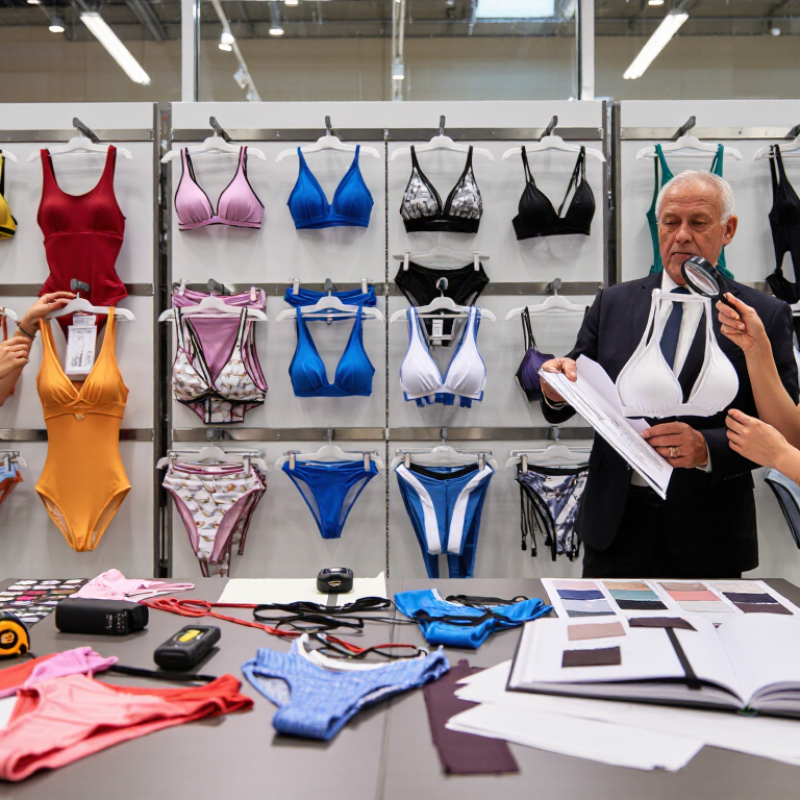
Define Your Bikini Swimwear Sourcing Goals and Product Requirements
How to Source Bikini Swimwear in 2026?
Define the customer before contacting factories. Specify age range, body shapes, coverage, price target, and sales channel. A practical brief should state the expected retail price and acceptable factory cost. It should also include minimum order quantity, size range, color count, and delivery window. Keep the first collection focused. Too many options can weaken quality control.
Material choices need measurable goals. Textile Exchange’s Materials Market Report 2024 states that global fiber production reached 124 million tonnes in 2023. Polyester represented about 57% of that volume. This supports asking suppliers for recycled-fiber evidence, fabric composition, and chain-of-custody records. Do not accept “eco-friendly” as a complete specification. Request fabric weight, stretch recovery, chlorine resistance, colorfastness, lining details, and seam construction. Small details matter.
Fit testing should happen before bulk production. Test bikinis on several body types, not only one mannequin. Check transparency when wet, elastic pressure, cup stability, and movement during swimming. Independent laboratory testing can verify fiber content and performance claims. Grand View Research projects continued growth in the global swimwear market through 2030, although forecasts vary by methodology. That uncertainty deserves attention. A lower MOQ may reduce inventory risk, but it can raise unit costs. I would rather approve a slower, better-documented launch than chase an attractive quotation with unclear specifications.
How to Source Bikini Swimwear in 2026? - Define Your Bikini Swimwear Sourcing Goals and Product Requirements
| Requirement Area | Sourcing Goal | Recommended 2026 Requirement | Planning Benchmark | Verification Method | Priority |
|---|---|---|---|---|---|
| Target Market | Define the customer and selling environment before product development. |
|
Prepare one written customer profile and one price-position statement for each collection. | Review the product brief, competitor assortment, and customer research before sampling. | High |
| Collection Size | Control development cost while offering enough commercial variety. | Start with 3–6 bikini styles, 2–4 colorways per style, and a consistent size range. | A focused first collection generally requires fewer samples, less fabric commitment, and simpler inventory planning than a large launch. | Check the number of unique patterns, trims, fabrics, colors, and size combinations. | High |
| Bikini Silhouette | Match the silhouette to the intended customer and level of support. |
|
Use adjustable straps and removable pads when fit flexibility is important; use wider underbust bands for higher support. | Evaluate fit on at least three representative body sizes and conduct movement testing. | High |
| Fabric Composition | Select a fabric that balances stretch, recovery, comfort, durability, and cost. | Common starting specifications include 80–82% recycled or virgin polyamide with 18–20% elastane, or polyester-elastane alternatives. | Four-way stretch and strong recovery are preferred for close-fitting swimwear; exact composition depends on the fabric mill and market claim requirements. | Confirm fiber content through supplier documentation and independent fiber-composition testing. | High |
| Fabric Weight | Achieve adequate coverage without making the garment unnecessarily heavy. | Use approximately 180–240 g/m² for many standard double-layer bikini fabrics; consider lighter or heavier constructions according to design. | Higher fabric weight can improve opacity and body, while lining, color, and construction also affect coverage. | Measure fabric weight from production-quality fabric and check opacity when wet and dry. | High |
| Stretch and Recovery | Prevent bagging, rolling, and loss of shape after repeated wear. | Set a documented stretch target in both fabric directions and define acceptable recovery after repeated extension. | Many swimwear fabrics are designed for approximately 20–40% crosswise stretch, but the correct value depends on pattern ease and fabric construction. | Use a fabric stretch-and-recovery test, followed by repeated wear and laundering evaluation. | High |
| Lining and Opacity | Reduce transparency and improve comfort, especially in light colors. | Specify full or partial lining, lining fiber content, lining color, and whether lining must match the shell fabric. | Double-layer construction is commonly preferred for pale colors, high-stretch designs, and styles intended for active movement. | Inspect the garment under direct light and test both dry and wet opacity. | High |
| Color Range | Build a commercially manageable palette with reliable repeatability. | Begin with 4–8 colors per seasonal collection, including core neutrals and a limited number of trend colors. | Require a physical lab dip or strike-off for each color before bulk approval; digital color previews are not sufficient for final approval. | Approve color against a recognized color standard or an approved physical reference under controlled lighting. | Medium |
| Colorfastness | Minimize fading, staining, and color transfer during use and care. | Set minimum test requirements for washing, perspiration, water, seawater, chlorinated water, and light exposure. | For many export programs, a minimum grade of 4 is used as a practical target for several colorfastness tests; buyer and destination-market requirements may differ. | Request laboratory reports for production fabric and conduct approval testing on finished garments. | High |
| UV Protection | Support sun-protection claims only when the finished material has been tested. | Use a UPF 50 or UPF 50+ claim only when supported by an applicable laboratory test and when the construction remains compliant after care testing. | UPF performance can vary with color, wetness, stretch, fabric weight, and garment coverage; it is not automatically guaranteed by fiber content. | Obtain a current UPF report for the actual fabric or finished garment and confirm permitted claim language. | High |
| Hardware and Trims | Ensure that decorative and functional components resist salt water, chlorine, and corrosion. | Define requirements for rings, sliders, hooks, clasps, beads, cords, pad inserts, and metal-free alternatives. | Use swimwear-grade hardware and verify that components do not become sharp, brittle, discolored, or loose after exposure testing. | Conduct corrosion, chlorine, seawater, pull, and repeated-use tests as appropriate for each component. | High |
| Seam Construction | Deliver comfort and durability without visible seam failure. | Specify seam type, stitch density, elastic width, bartack locations, edge binding, and allowable puckering. | Use soft elastic and smooth seam finishing at high-contact areas; test stress points such as leg openings, straps, and closures. | Perform seam-strength, stretch, wash, and visual workmanship inspections. | High |
| Size Range | Reduce fit-related returns and serve the intended customer base. | Define a complete size chart with bust, underbust, waist, hip, torso, and cup or support information where relevant. | A starting range such as XS–XL or XS–2XL may be suitable for some programs, but the final range should reflect demand and grading capability. | Fit samples on the smallest, middle, and largest planned sizes; check grading between sizes. | High |
| Fit Tolerance | Maintain consistent measurements between production units. | Issue a technical measurement chart with points of measure, tolerances, construction diagrams, and approved sample references. | Common garment measurement tolerances are often around ±0.5–1.0 cm for critical points, subject to the buyer’s specification and garment area. | Measure pre-production and bulk samples using the approved measurement chart. | High |
| Minimum Order Quantity | Balance unit cost with inventory risk and cash-flow limits. | Request MOQ separately for style, color, fabric, and size breakdown instead of accepting one combined MOQ. | Small-batch programs may begin around 100–300 pieces per color, while larger factories may quote higher minimums; actual MOQ depends on fabric, trims, and production capacity. | Compare at least three written quotations showing unit price, MOQ, sampling charges, and tooling or setup fees. | High |
| Target Cost | Keep the product commercially viable after freight, duties, packaging, and selling costs. | Set a target ex-factory or FOB cost before final design approval and calculate the complete landed-cost estimate. | Target cost varies substantially with fabric, hardware, lining, construction, order quantity, testing, and packaging; avoid using a single market-wide average. | Use a costed bill of materials and request an itemized quotation from each shortlisted supplier. | High |
| Sampling Plan | Identify fit and construction problems before bulk production. | Plan for design or proto sample, fit sample, size-set sample, pre-production sample, and shipment or random inspection sample when needed. | Allow at least two fit-review rounds for new patterns or complex support constructions. | Record comments with photographs, measurements, revision dates, and sample approval signatures. | High |
| Development Timeline | Align product development with the selling season and launch date. | Build a calendar covering fabric approval, pattern development, sampling, testing, order placement, production, inspection, and shipping. | Typical sampling may take 1–3 weeks per round, while bulk production often requires several additional weeks after material approval; complex programs require more time. | Obtain a dated critical-path schedule and update it after every approval or change. | High |
| Production Lead Time | Protect the launch date and reduce rush-production costs. | Confirm whether lead time starts from deposit, fabric approval, purchase-order confirmation, or final sample approval. | A practical planning window is often 45–90 days for bulk production after all materials and approvals are ready, excluding transit. | Compare the supplier’s written schedule with the required in-warehouse date and add a contingency buffer. | High |
| Compliance and Testing | Reduce regulatory, chemical, safety, and customer-claim risk. | Define destination-market requirements for fiber labeling, care labeling, chemicals, packaging, flammability where applicable, and social compliance. | Testing must be based on the actual destination market and product claims; a generic certificate does not cover every legal obligation. | Use an independent laboratory and retain reports that identify the tested material, color, style, and production date. | High |
| Sustainability Claims | Make environmental statements that are specific and supportable. | For recycled-content claims, define the required percentage, certification or chain-of-custody evidence, product scope, and labeling wording. | Do not describe a product as recycled, recyclable, biodegradable, or sustainable without evidence covering the exact material and claim. | Check transaction certificates, scope documents, supplier declarations, and applicable claim rules before printing labels or marketing copy. | High |
| Packaging | Protect the garment while controlling material use and shipping volume. | Specify polybag dimensions, carton quantity, folding method, barcode or SKU label, warning language, and recycled-content requirements. | Use packaging that prevents moisture, snagging, and color transfer; optimize carton dimensions to reduce unused shipping space. | Approve a packaging sample and perform carton drop, moisture, labeling, and assortment checks where appropriate. | Medium |
| Quality Inspection | Detect defects before goods leave the production site. | Define acceptable quality limits, measurement tolerances, critical defects, major defects, minor defects, and inspection stages. | Many commercial inspection programs use an AQL-based sampling approach, but the exact inspection level and acceptance limits must be agreed in writing. | Conduct in-line, final random, or pre-shipment inspection using an approved checklist and production reference sample. | High |
| Logistics and Incoterms | Calculate the actual landed cost and assign responsibilities clearly. | Confirm Incoterms, port or airport, carton measurements, gross weight, shipping mode, insurance, customs documents, and delivery date. | Compare sea, rail, air, and courier options according to order size, urgency, and destination; transport prices fluctuate and require current quotations. | Request a freight quotation using final carton data and review commercial invoices, packing lists, and required export documents. | High |
| Supplier Evaluation | Select a production partner capable of meeting technical and commercial requirements. | Assess swimwear experience, pattern and development capability, fabric access, testing support, capacity, quality system, communication, and ethical-risk controls. | Shortlist at least 3–5 qualified suppliers and compare them using the same brief, sample standards, and quotation format. | Review factory evidence, sample quality, references where available, audit records, and a completed supplier questionnaire. | High |
| Payment and Risk Control | Limit financial exposure before product quality is proven. | Document deposit percentage, balance timing, currency, payment method, ownership of patterns and molds, cancellation terms, and remediation for defects. | Payment structures vary by supplier and order size; link final payment to agreed inspection or release conditions whenever commercially possible. | Use a signed purchase order or manufacturing agreement and verify bank details through a controlled process. | High |
Related Posts
-
2025 How to Choose the Perfect Girls Shoes for Every Occasion
-
Why Choosing the Right Swimming Costume Women Matters for Comfort and Style?
-
How to Choose the Best Gym Clothes for Maximum Comfort and Performance
-
Top 10 Clothing Stores You Need to Shop From Now?
-

Essential Checklist for Choosing the Perfect Ladies Gym Wear for Every Workout
-
Why Choose Swimming Costumes for Women?